

Say Hello!

Scroll


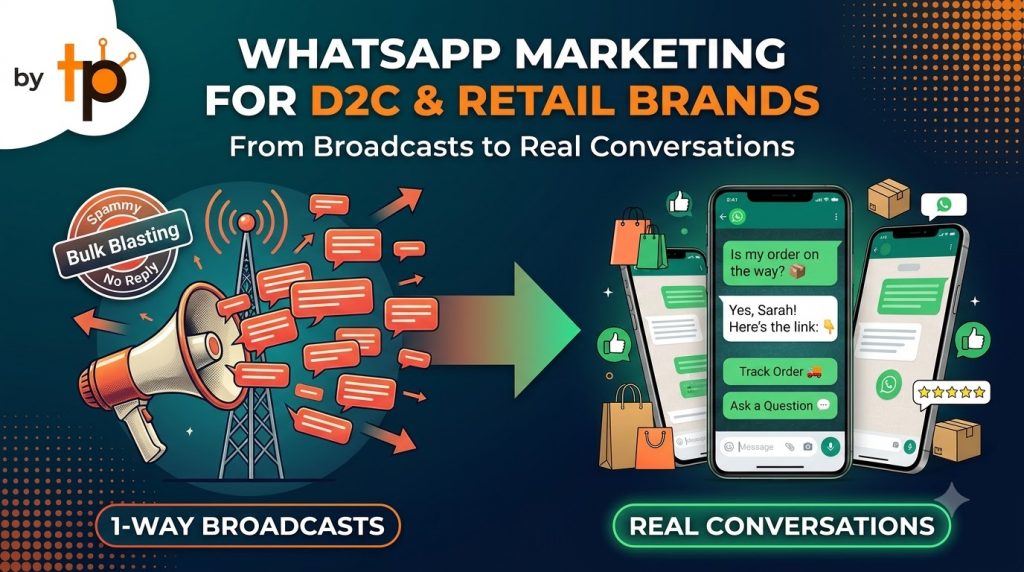
WhatsApp marketing means using WhatsApp to talk to customers one-to-one. Brands use it for order updates, product questions, offers and support. It works best when messages are expected, useful and easy to reply to, and when the chat connects to your store and CRM.
Why is WhatsApp marketing growing so fast?
Customers already spend their day in messaging apps. A brand that meets them there skips the inbox and the app download.
It is also two-way. A shopper can ask about size, delivery or returns and get an answer in the same thread that carries their order. That makes WhatsApp a sales channel and a support channel at once.
WhatsApp marketing myths vs facts
| Myth | Fact |
| WhatsApp is only for customer support | It drives discovery, orders and repeat purchases too |
| More broadcasts mean more sales | Unwanted messages get muted or blocked |
| It works on its own | It works best linked to your store, CRM and ads |
| Only big brands can use it | Small D2C brands often see the most benefit |
A 4-step framework for WhatsApp marketing
Step 1: Get permission the right way
Ask customers to opt in at checkout, on product pages or after a support chat. Tell them what they will receive and how often.
Step 2: Connect WhatsApp to your store
Omnichannel selling works when the chat knows the customer. A Shopify, Meta and WhatsApp integration lets order details, cart data and ad clicks flow into one conversation.
Step 3: Build useful message journeys
Start with messages people actually want: order confirmations, delivery updates, back-in-stock alerts and abandoned-cart reminders. Add offers only after trust is built.
Step 4: Automate the routine, keep humans for the rest
AI chatbots can answer common questions at any hour. Some can even detect the emotional tone of a message and pass upset customers to a person. Brands exploring this can look at conversational AI chatbots built for customer experience.
Common WhatsApp marketing mistakes to avoid
• Sending the same broadcast to every customer
• Messaging without clear opt-in
• Leaving replies unanswered for hours
• Treating WhatsApp as separate from email and social
• Measuring only messages sent, not orders or replies
Conversational commerce should feel like a helpful shop assistant, not a loudspeaker. Email still has a role alongside it, and the basics in these email marketing do’s and don’ts apply to WhatsApp too.
WhatsApp marketing case study: award-winning messaging campaigns
Messaging campaigns have earned real recognition. Team Pumpkin’s work for iAm won Best Use of WhatsApp, and the same work picked up Best Mobile Messaging Campaign at both the e4m Maddies and the MMA Smarties in 2020. The full list sits among the agency’s mobile messaging campaign awards.
How Team Pumpkin helps with WhatsApp marketing
Team Pumpkin connects WhatsApp to Shopify stores, CRMs and Meta ads, so every chat carries context. Its AI team builds customer experience chatbots and workflow agents, while content teams write message journeys that sound like the brand.
The goal is simple: fewer blasts, more conversations that turn into orders and customer retention. That is how Team Pumpkin approaches every messaging programme.
Frequently Asked Questions
1.Is WhatsApp marketing allowed without permission?
No. Customers should opt in first, and they should be able to stop messages easily.
2.What messages work best on WhatsApp?
Order updates, delivery alerts, back-in-stock notices and cart reminders. They are useful, so people read them.
3.Can WhatsApp connect to a Shopify store?
Yes. Shopify, Meta and WhatsApp can be integrated so order and cart data appear in the chat.
4.Should brands use chatbots on WhatsApp?
Yes, for routine questions. Complex or emotional conversations should still reach a person.
5.How do you measure WhatsApp marketing?
Track opt-ins, reply rates, orders from chats, repeat purchases and opt-outs.
Key takeaways on WhatsApp marketing
• WhatsApp works as both a sales and a support channel
• Permission and relevance matter more than message volume
• Connecting chats to your store and CRM makes them far more useful
• Chatbots handle routine questions, while people handle the rest
Ready to turn broadcasts into conversations? Start with one useful message journey and build from there.