

Say Hello!

Scroll


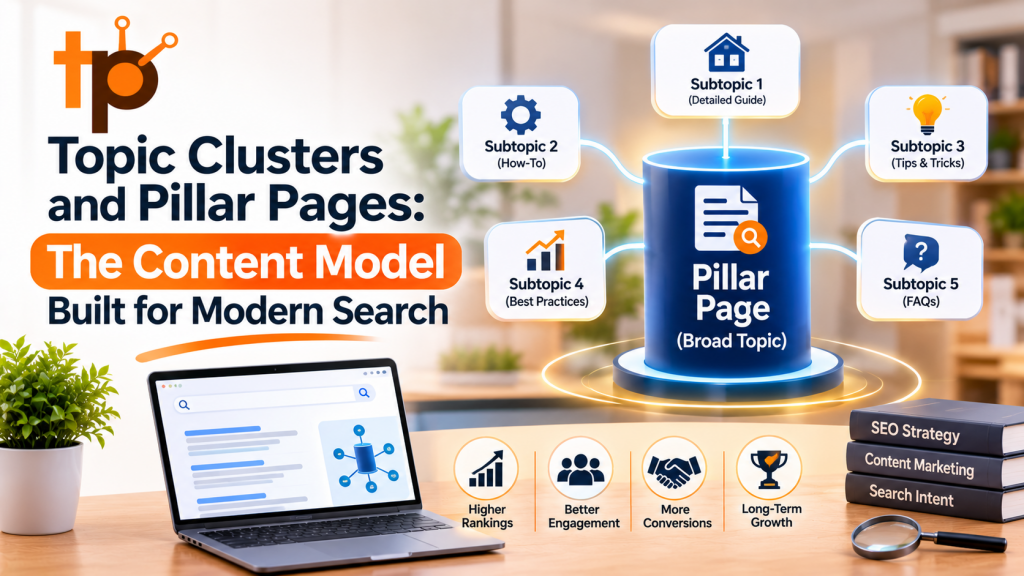
Topic clusters fix a common problem: many company blogs look like a pile of loose notes. A post on one topic this week, something unrelated the next, and nothing that ties them together.
Search engines, and AI answers, increasingly favour sites that cover a subject thoroughly. This structure turns scattered posts into a connected library that shows real expertise.
What is a topic cluster?
A topic cluster has two parts. A pillar page covers a broad subject in depth. Cluster pages each go deep on one narrower question, and every one of them links back to the pillar.
Together they signal topical authority: this site does not just mention the subject, it covers it from every angle.
Topic cluster example: pillar page and cluster pages
| Page | Role | Example title |
| Pillar | Broad guide | The complete guide to ecommerce SEO |
| Cluster | Narrow question | How to write product descriptions that rank |
| Cluster | Narrow question | Fixing duplicate content on category pages |
| Cluster | Narrow question | Schema markup for product pages |
| Cluster | Narrow question | Speeding up ecommerce sites for mobile |
| Service page | Conversion | Ecommerce SEO services |
The service page is the destination. Pillars and clusters bring the reader there.
How to build a topic cluster in 5 steps
1. Pick a topic tied to revenue. Choose a subject close to what you actually sell.
2. List the questions buyers ask. Use search data, sales calls and FAQs.
3. Write the pillar first. Make it the best overview on the subject.
4. Publish clusters steadily. One or two a month beats ten in a week and then silence.
5. Link deliberately. Every cluster links to the pillar, and the pillar links to every cluster.
How internal linking connects a topic cluster
Without links, a cluster is just a set of separate posts. Internal linking tells search engines how the pages relate, and it moves readers from learning to buying.
Use descriptive anchor text and avoid linking every page to every other page. Each link should help the reader take the next step. Teams that want a cluster strategy planned and written in-house often turn to in-house content strategists.
How to keep topic clusters fresh
Update the pillar when the topic changes, refresh clusters with new examples, and merge thin posts that cover the same ground. Fresh, consolidated content ranks better than a growing archive of near-duplicates.
How Team Pumpkin approaches topic clusters
The agency’s content SEO work starts with topic cluster and pillar strategies, SEO content calendars mapped to funnel stages, and keyword-focused landing pages and blogs. At Team Pumpkin, writing, editing, design and publishing all happen in-house.
Team Pumpkin’s content work won Best Content Marketing (Annual Plan) at the E4m Indian Content Marketing Awards 2020, as listed on the awards page.
Each cluster is then backed by on-page optimisation and link building through its on-page SEO team.
Frequently Asked Questions
1.How many cluster pages should a pillar have?
Start with five to eight, then add more as you find new buyer questions.
2.Can old blog posts become cluster pages?
Yes. Update them, link them to a pillar, and merge any that overlap.
3.How long until topic clusters show results?
It takes steady publishing and linking over several months, as with most organic growth.
4.What is a pillar page?
It is a broad, in-depth guide to one topic that links out to narrower cluster pages, and they all link back to it.
5.Do topic clusters help with AI search?
Yes. Covering a subject from every angle makes a site more likely to be treated as a trusted source.
Conclusion
Authority is built, not claimed. Organise your content into clusters, link it with purpose, and search engines will start treating your site as the place to go for answers. Team Pumpkin builds content libraries on this model for brands across industries.