

Say Hello!

Scroll


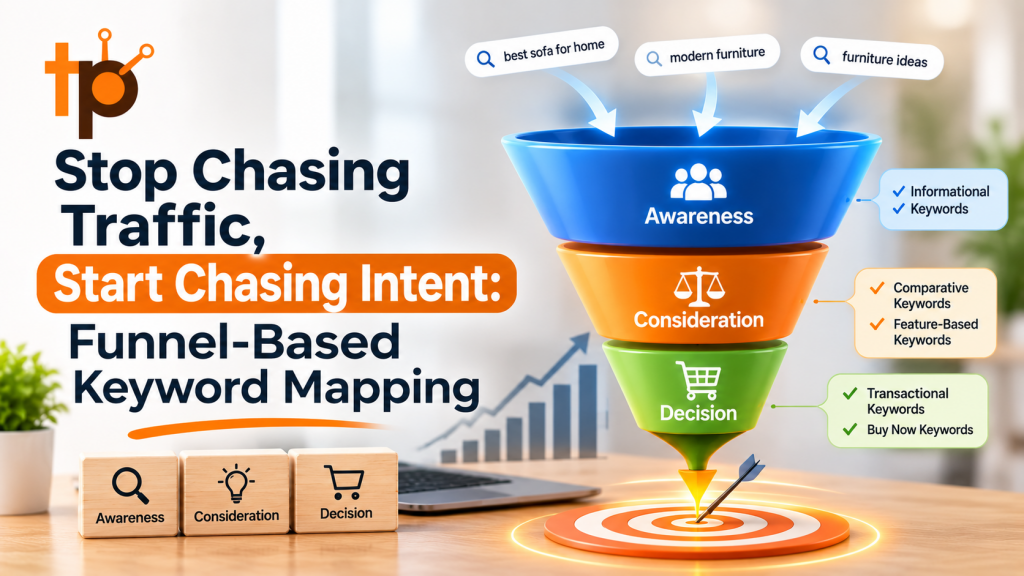
The dashboard looks great. Organic sessions are up, blog views are climbing, and the SEO report is full of green arrows. Yet the sales team says the leads have not changed, and weak keyword mapping is often the reason.
This happens when content ranks for words people search out of curiosity, not words people search when they are ready to act. Keyword mapping by funnel stage fixes that mismatch.
What is funnel-based keyword mapping?
It means sorting keywords by where the searcher is in their buying journey, and giving each stage its own page type. One keyword, one main page, one clear purpose.
It also stops two of your own pages from competing for the same search, which quietly weakens both.
Which keywords fit each stage of the sales funnel?
| Funnel stage | What the searcher wants | Example query style | Best page type |
| Awareness | To understand a problem | “why is my website traffic falling” | Guides, explainers, blogs |
| Consideration | To compare options | “in-house SEO vs agency” | Comparisons, FAQs, checklists |
| Decision | To choose and buy | “SEO company in Mumbai” | Service pages, landing pages, case studies |
Most brands overload the awareness stage. Buyer intent keywords at the decision stage get less volume, but they bring the visitors who convert.
Why do long-tail keywords convert better?
Long-tail keywords are longer, more specific phrases. Fewer people search them, but the people who do know exactly what they want.
They are also how people talk to voice assistants and AI search. A page that answers a narrow, specific question well often beats a broad page that answers everything loosely.
How to turn a keyword map into an SEO content calendar
A keyword map is only useful once it drives publishing. Build an SEO content calendar that:
1. Fills gaps at the decision stage first
2. Adds two or three consideration pieces for every key service
3. Plans awareness content around seasonality and search trends
4. Links each awareness blog to the matching service page
The last step matters most. Internal links guide readers, and search engines, from curiosity to conversion. Brands that want the calendar and the writing handled together often use dedicated content marketing services.
Why review your keyword map every month
Search behaviour shifts with seasons, launches and news. A monthly review spots new opportunities and drops keywords that stopped converting.
How Team Pumpkin approaches keyword mapping
The agency’s keyword research strategy maps keywords by funnel stage, from awareness to purchase intent. It covers local and long-tail terms and tracks opportunities monthly, based on seasonality and search trends.
Team Pumpkin’s content plans are keyword-first, so every blog and landing page has a defined job. Dashboards then report organic traffic and conversions by goal, through the agency’s search engine optimisation programme.
Frequently Asked Questions
1.How many keywords should one page target?
One primary keyword, plus a few close variations. Each main keyword should have one home page on your site.
2.Are high-volume keywords bad?
No, but on their own they rarely bring buyers. Balance them with decision-stage and long-tail terms.
3.How often should a keyword map be updated?
Monthly is a good rhythm, and it is the cadence Team Pumpkin follows, with a bigger review before peak seasons.
4.What is keyword cannibalisation?
It happens when two pages on your site target the same keyword and compete with each other. A keyword map prevents it by giving each keyword one home page.
5.What are decision-stage keywords?
They are searches from people ready to act, such as a service plus a city name. They should lead to service or landing pages.
Conclusion
Traffic is a means, not the goal. First, map every keyword to a stage. Then, give every stage the right page, and your SEO numbers will start matching your sales numbers. That is the approach Team Pumpkin takes with every SEO and content plan.