

Say Hello!

Scroll


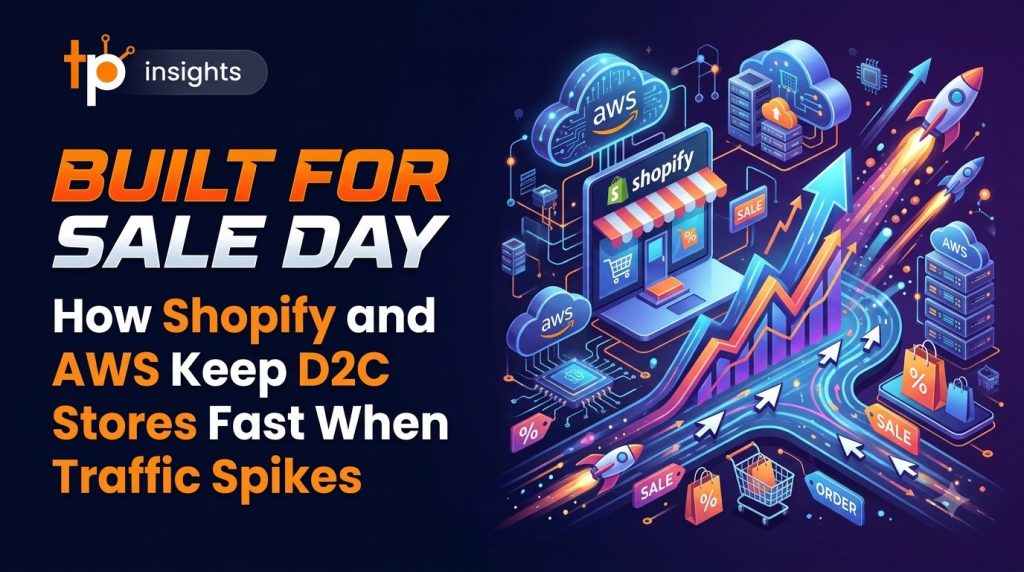
The influencer post goes live. The product drop is trending. Thousands of shoppers land on the store at once, and the checkout freezes. By the time it recovers, most of them have left. Shopify development built for traffic spikes prevents exactly that.
For D2C brands, the website is the shop floor. Shopify development paired with strong cloud infrastructure is how fast-growing brands make sure their busiest day is also their best one.
Shopify gives brands a flexible, proven commerce platform: themes, checkout, subscriptions and apps. AWS adds cloud power around it: fast content delivery, extra computing when traffic jumps, secure storage and data tools.
Together they cover both sides. Shopify runs the store, and AWS keeps everything around it fast and always on.
| Layer | What it does | Why it matters on sale day |
| Custom Shopify 2.0 theme | Mobile-first, speed-optimised storefront | Fast pages convert more shoppers |
| CDN integration | Serves content from locations near the shopper | Quicker loads everywhere |
| Auto-scaling on AWS | Adds capacity when traffic jumps | No crash during drops and sales |
| Custom checkout and subscriptions | Smooth, branded buying flow | Fewer abandoned carts |
| AWS S3 storage | Media, backups and version control | Safe, fast assets |
| Analytics dashboards | Live view of sales and behaviour | Faster decisions mid-sale |
Headless commerce separates the storefront from the Shopify back end. The front end can be built with tools like Hydrogen, Next.js or React. It gives brands full design freedom and very fast pages, while Shopify still handles products and orders.
It suits brands with rich content, complex catalogues or ambitious design. For simpler stores, a well-built custom theme is often enough. Brands comparing options can explore broader custom web development options too.
With customer data platforms hosted on AWS, stores can show dynamic product recommendations, segment customers and run AI-powered cart recovery and retargeting. The store stops being a static catalogue and starts responding to each shopper.
Many brands outgrow their first platform. Common upgrades include Shopify to Shopify Plus, and migration from Magento, WooCommerce or custom platforms. A performance audit before the move shows what to fix, so the new store launches faster than the old one ran.
Team Pumpkin combines certified Shopify expertise with an AWS cloud engineering team. The work covers custom Shopify builds, AWS hosting and performance, app and headless integrations with CRMs, ERPs and order systems, D2C personalisation, and migration with 24×7 support.
It has delivered this for beauty, apparel, tech, FMCG and lifestyle brands, with creative, performance and platform growth all under one roof at Team Pumpkin.
The full scope, from store design to infrastructure and automation, is on the Shopify and AWS expertise page.
1.Why would a Shopify store need AWS?
For extra speed, scaling during traffic spikes, secure storage, automated workflows and advanced analytics around the store.
2.What is headless commerce?
It is a setup where a custom front end connects to Shopify’s back end, giving more design freedom and speed.
3.Can I migrate from Magento or WooCommerce to Shopify?
Yes. A planned migration moves products, customers and orders while protecting SEO.
4.What is Shopify Plus?
It is Shopify’s plan for high-growth brands that need more customisation and scale. Many brands upgrade to it as they grow.
5.How does AWS help during a product drop?
Auto-scaling adds capacity when traffic jumps, and a CDN keeps pages fast for shoppers wherever they are.
Sale day is when a D2C brand is tested hardest. Build on a flexible platform, back it with cloud infrastructure that scales, and the moment your marketing works, your store will be ready for it. Team Pumpkin builds stores with that moment in mind.