

Say Hello!

Scroll


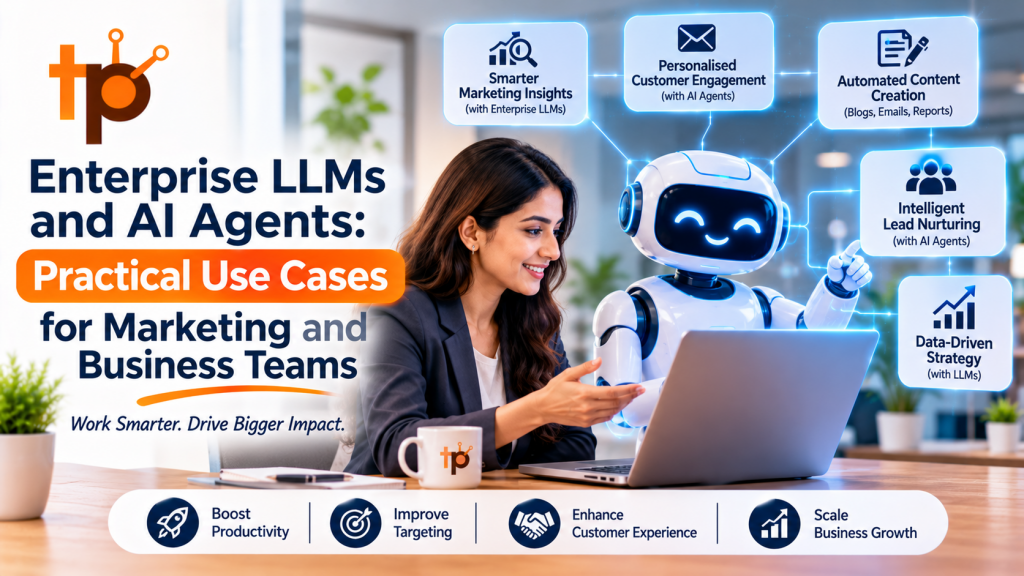
Most companies have tried a public AI chatbot by now. Far fewer have turned enterprise AI solutions into something that runs inside their own business, on their own data, with proper controls. That gap is where the real value sits.
Enterprise AI solutions are not about chasing hype. They are about choosing a few clear jobs, building AI that does them well, and scaling once it proves its worth.
AI agents vs enterprise LLMs: what is the difference?
An AI agent acts. It makes decisions in real time, personalises content or handles support requests on its own. A private LLM knows. It is a language model trained or tuned on your company’s information, kept secure and under your control.
Many of the strongest solutions combine both: an agent that draws on a private model to answer and act.
Enterprise AI use cases by team
| Team | Use case | What it improves |
| Customer experience | Chatbots that detect emotional tone | Faster, more human support |
| Retail and ecommerce | Recommendation engines and real-time bundling | Basket size and conversion |
| Operations and HR | Workflow agents | Time spent on routine tasks |
| Knowledge management | Assistants trained on internal data | Faster answers for staff |
| Legal and compliance | Document summarisation | Review time |
| Finance | LLM-based risk modelling | Speed of analysis |
| Website and support | Dynamic FAQ systems | Self-service rates |
5 questions to answer before building an enterprise AI solution
1. What exact problem are we solving? Start with one workflow, not “AI everywhere”.
2. Where does the data live, and is it clean? AI is only as good as what it learns from.
3. What must stay private? Enterprise controls and security-first design matter from day one.
4.Can we explain its answers? Avoid black boxes, especially in regulated areas.
5. How will we measure success? Time saved, cost reduced or revenue added.
How to plan AI infrastructure for scale
A pilot running on one laptop is very different from a system serving thousands of users. AI infrastructure decides whether a project survives growth. That means model orchestration, containerised deployment, GPU-based autoscaling for peak traffic, and monitoring with model versioning.
Teams should also compare on-premise and cloud options before committing. Brands moving from pilot to production can explore end-to-end AI solutions that cover the full path.
How Team Pumpkin approaches enterprise AI solutions
Team Pumpkin builds intelligent agent systems, enterprise LLM solutions, AI-native applications, generative content engines, multimodal systems and the infrastructure to run them. Team Pumpkin’s work spans D2C, tech, media and marketing.
The approach is security-first and transparent, with explainable AI and full-stack delivery from strategy to deployment. AI also feeds into apps, through predictive analytics dashboards and personalisation engines. More detail is on the AI-powered app development page.
Frequently Asked Questions
1.What is an enterprise LLM?
A large language model built or tuned for one company’s data and needs, with enterprise-grade security and controls.
2.Are AI agents safe for customer-facing work?
Yes, when they are tested, monitored and limited to clear tasks, with a human escalation path.
3.How should a company start with AI?
Pick one high-value workflow, run a focused pilot, measure results, then scale.
4.What is a private LLM?
It is a language model trained or tuned on a company’s own data and kept under that company’s control.
5.Should enterprise AI run on-premise or in the cloud?
It depends on security needs, cost and scale. Benchmark both options before committing.
Conclusion
The companies getting real value from AI are not doing everything at once. They pick sharp problems, keep their data secure, explain what the AI does, and build for scale from the start. Team Pumpkin works with businesses on that path, from pilot to platform.